The Music Tree Methodology is an innovative music teaching system that deeply integrates digital technology with the laws of early childhood physical and mental development. With "Education of Love" as its main theme and a "spiral" curriculum structure, it provides a full-process solution for kindergartens ranging from resources and teaching to evaluation.
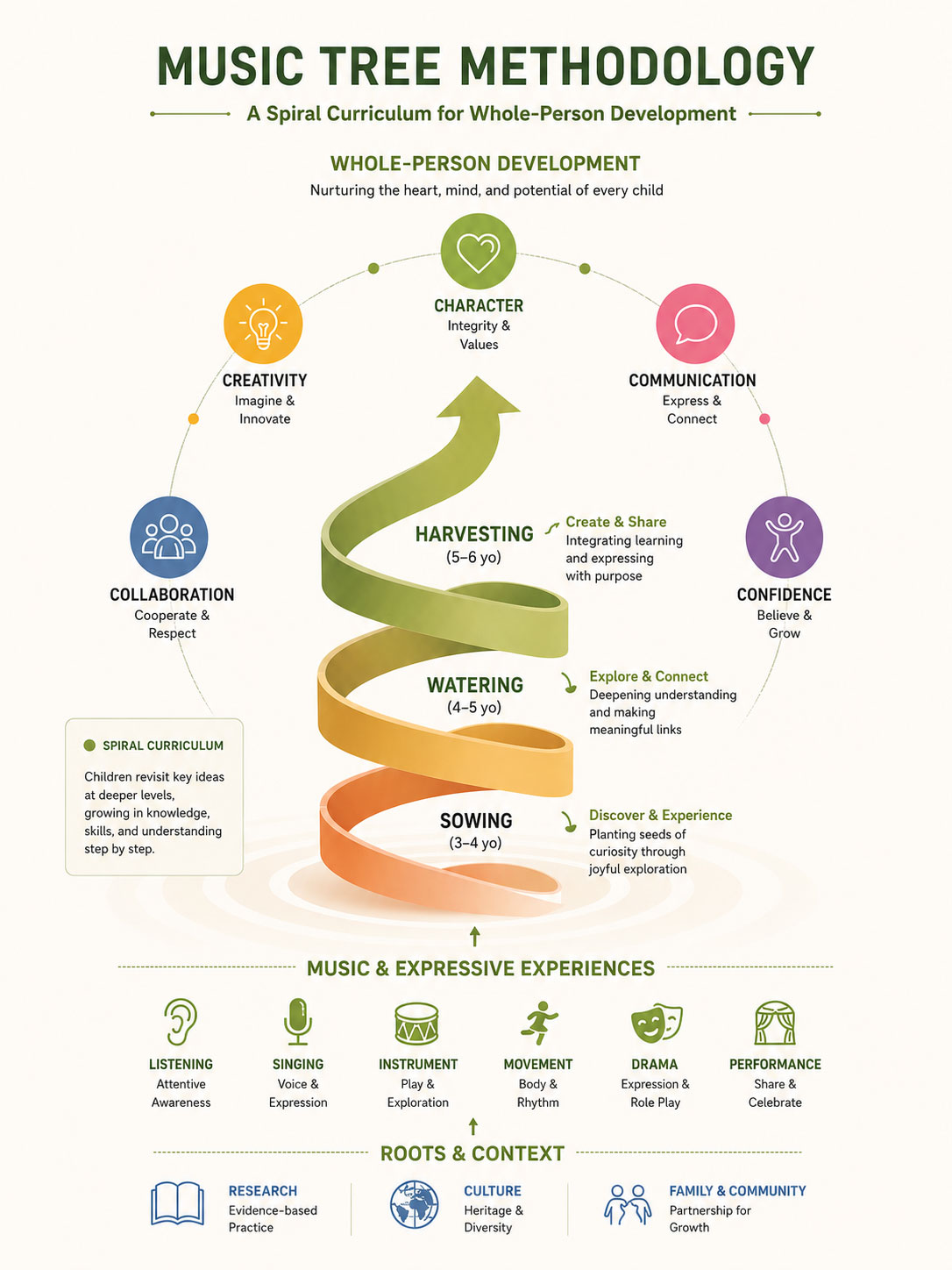
The Music Tree Methodology is designed for the 3–6-year-old preschool stage, using music as the core medium to construct children’s fundamental learning experiences. Through music activities, it naturally integrates educational content from multiple domains, including creativity, confidence, communication, collaboration, and character, promoting holistic development in young children. The curriculum adopts a spiral learning design, allowing children to revisit and deepen musical experiences progressively, thereby integrating overall growth with continuous musical exploration.
Within this framework, the method establishes a three-stage spiral growth model. The first stage, “Sowing the Seeds of Music,” stimulates children’s interest through listening activities and initial instrument experiences. The second stage, “Nurturing the Flowers of Music,” deepens musical understanding and expression through singing, movement, and performance activities. The final stage, “Harvesting the Fruits of Music,” integrates children’s abilities through comprehensive artistic practices, enabling them to experience achievement and joy through creative musical expression.

The Music Tree Digital Resource Platform is a global service ecosystem that seamlessly integrates educational technology with pedagogical practice. By connecting schools and families, we create a holistic environment for early childhood development.
Includes the "Education Guidance Outline," which clarifies activity goals, classroom preparation core experiences, evaluation systems, classroom extensions, and home-school cooperation strategies for each theme, as well as the "Teaching Activity Guide" (containing 9 themes and 36 lessons, with detailed lesson plans for four types of musical activities: listening, instruments, singing, and performance, along with supporting song collections, scene music collections, and percussion work collections).
Teacher's Action Companion (Dynamic Guide for Experiential Learning and Reflective Music Tree Methodology) is a cornerstone publication within the "Music Tree Pedagogy" early childhood education series. Developed in precise alignment with the Kindergarten Music Activity Curriculum Framework and Teaching Guide, this manual unfolds systematically across three progressive phases. Guided by the core mission of "Music Tree Holistic Education," it introduces the innovative "Panoramic Map of Core Competencies for Children’s Whole-Person Development," serving as a vital pillar in the systematic construction of Music Tree’s Resources & Environment. Breaking down traditional disciplinary barriers, this companion is designed to empower every frontline educator. With its dynamic and reflective guidance, even non-specialist teachers with zero music background can confidently transform into facilitators of children's musical journeys—seamlessly shifting from technical skill instruction to meaningful whole-person cultivation.
A three-volume "MusicTree" series corresponding to the three growth stages, featuring wordless designs with designated areas for doodling, connecting lines, filling in, and mazes to promote autonomous exploration; the storylines are continuous, relatable to life, and align with modern family structures.
Such as "3D Interactive Aprons," "Handheld Octave Harps," and "Note Color Cards" to enhance situational immersion.
Through the deep integration of the "Music Tree" curriculum resource platform and specialized teaching aids, the Kindergarten Music Room creates space for children's individuality to flourish. The digital environment fosters situational experiences, building a bridge from the abstract to the concrete, stimulating children's interest in exploring abstract, and rigid music knowledge and skills, making the teaching space a true music field belonging to the children.